Wednesday, November 24, 2021

Happy Thanksgiving


As families come together near and far to celebrate with food and fellowship while counting their many blessings, we would like to take this opportunity, too, to wish our Pack 1910 family a Happy Thanksgiving.

The first Thanksgiving was a celebration of the culmination of a successful partnership and harvest between different groups of people and was a further testimony that people of all creeds can live in harmony.

So, this Thanksgiving, we give thanks to children of all beliefs who have joined into the brotherhood and sisterhood of Scouting for the purpose of the greater good. We are united in a common purpose to be a different breed of person... the leaders of the future.

Thankful are we for the opportunities presented to us through the Scouting movement and the ability to serve our chartered organization, our community, our family, our unit and our country.

Thankful are we for the opportunity to Do A Good Turn Daily by acts of selfless service to those in our family, school and community.

Thankful are we for the blessings of leaders and volunteers who give of their time and their many talents to lead these Scouts with purpose.

Thankful are we for the bright-eyed enthusiasm as we witness young boys and girls take on greater responsibilities and meet challenges they didn't know they could overcome.

Thankful are we for the freedom afforded to all Americans and for those who are willing to fight for it... whatever the cost.

Thankful are we to not get everything we want, but to continue to be grateful for what we have.

Thankful are we for the partnership with nature and the outdoors as we learn to live in harmony with our earth and protect it for the generations that will follow.

Thankful are we for the gift of a merciful and gracious God that hears our prayers. Oh great Scoutmaster of all, please be with all of our Pack families until we can join together again.

Until that time... Happy Thanksgiving one and all!

Monday, November 15, 2021

Register for CUB-O 2022 Now!

Save the date and make plans to join us January 8, 2022 at CUB-O, the annual Cub Scout orienteering event held at Sid Richardson Scout Ranch.


Cub-O is probably the most popular Cub Scout orienteering event in North America. A fun day of hiking and friendly competition for Cub Scouts, parents, and leaders. Orienteering (the use of map and compass to find locations) lets Scouts plan a journey and has been a vital skill for humans for thousands of years. Thousands of people participate in the sport each year in local clubs and competitions. Longhorn Council has two events annually for orienteering. One is for Cub Scouts (Cub O), and one is held for Scouts BSA (SCORE-O).

Early Bird Registration is $20 per scout and adult and includes a patch, liability insurance and a Cub-O keepsake map. T-shirts are available to purchase at registration. Additional attendees (attending, assisting or camping but not competing) can pay $8 for liability insurance only but must register and be paid.  

***We are required to have 2 registered adults for every den we have attending. If there is a doubt we will need you as a walking chaperone, please register!

Lunch is NOT included so please bring your lunch with you to eat before the race. Each team of 3-6 Cubs gets a Cub-O map half an hour before the race starts. Your goal is to hike in the woods and find as many of the orange and white orienteering flags as you can.  The more difficult they are to access, the higher the point value.

Plan your strategy to score the maximum point total possible in 2 hours!


Map training sessions for Cub Scouts and parents are held all morning. Not sure if they'll be virtual again this year. That will be communicated shortly.

This is a rain or shine event: extreme inclement weather (ice or snow) may cause a one week postponement. Weather announcements will be made on the Longhorn Council Website and on our blog as well.

Sound like something you want to do? REGISTER ONLINE HERE.  Early bird registration ends DEC 11. 

It’s fast, exciting, and FUN. And it’s all Cub Scouts. The locations of 40-50 orange and white orienteering flags are marked on the map and you and your team will go hiking in the woods to find them – or most of them! Each flag has a hole punch that you use to mark your scorecard. Flags are worth 5, 10, 15, 20, or 30 points, depending on how hard they are to find. Your Den team will get a Cub-O competition map 20 minutes before the race starts. Then you plan a hiking strategy to find the most flags and score the most points in just 2 hours! You’ll stay warm ‘cause you’ll stay moving!

Cub-O is a team event for teams (Dens) of 3-6 Cub Scouts and at least 2 adults. Each team must have at least two adults registered for Cub-O. Be sure to dress warmly in layers and bring lots of water! Bring a compass and a watch so you’ll finish on time. All registered participants will get a Cub-O patch, our latest 5-color competition map, and a great day of orienteering.

Plan on about a 15-20 min drive from where Google shows the entrance to be.

We did not plan on this being a camping event but if the need exists, we can make it happen. Be sure to contact April.

Saturday, November 13, 2021

T-Shirts Orders are LIVE!

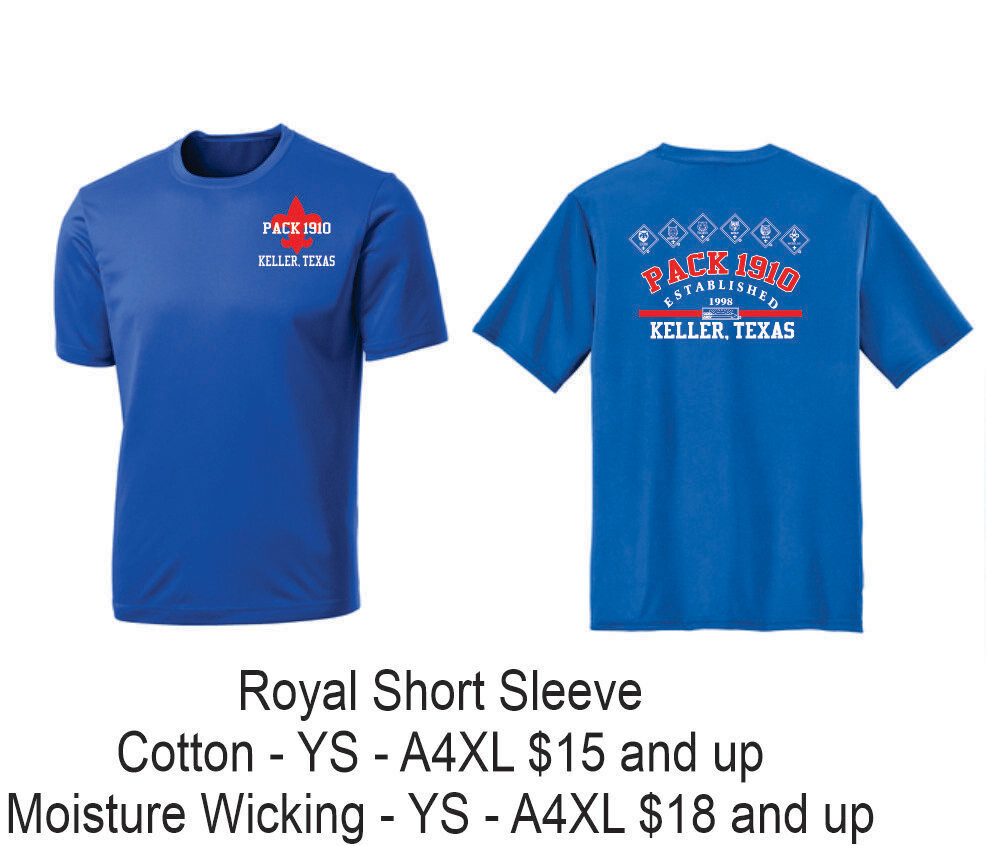
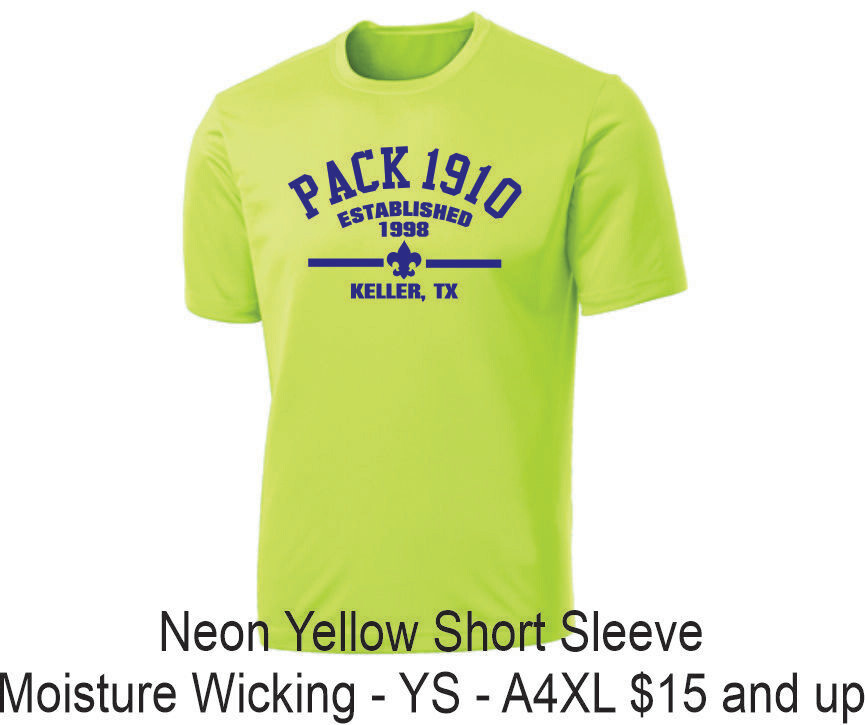
We are ready to take orders for our new Pack 1910 t-shirts.  

These shirts are great for Pack events, camping or just wearing out to show your Pack pride. Anytime an outing calls for "activity shirt" or a "scout shirt" (especially at camp outs) or even  a "Class B" shirt -- this is what we are talking about. 

Shown above, the official Pack 1910 t-shirts are royal blue with red and white ink. Scouts are provided one t-shirt when joining the Pack from whatever inventory is on hand for their desired size (which could be different designs from whatever inventory we have in stock). Additional t-shirts for your scout, siblings or parents are priced as marked on the order page. Note -- larger sizes and moisture wicking shirts do have an upcharge. 

For new families - if your scout has NOT received their shirt yet, send an email to Stephanie Earnhardt at Smb1218@gmail.com . She is coordinating our Unit t-shirts.  She will make sure that your Scout gets a shirt ordered no charge to you.  However, if you want ADDITIONAL shirts, you will need to order those yourself.

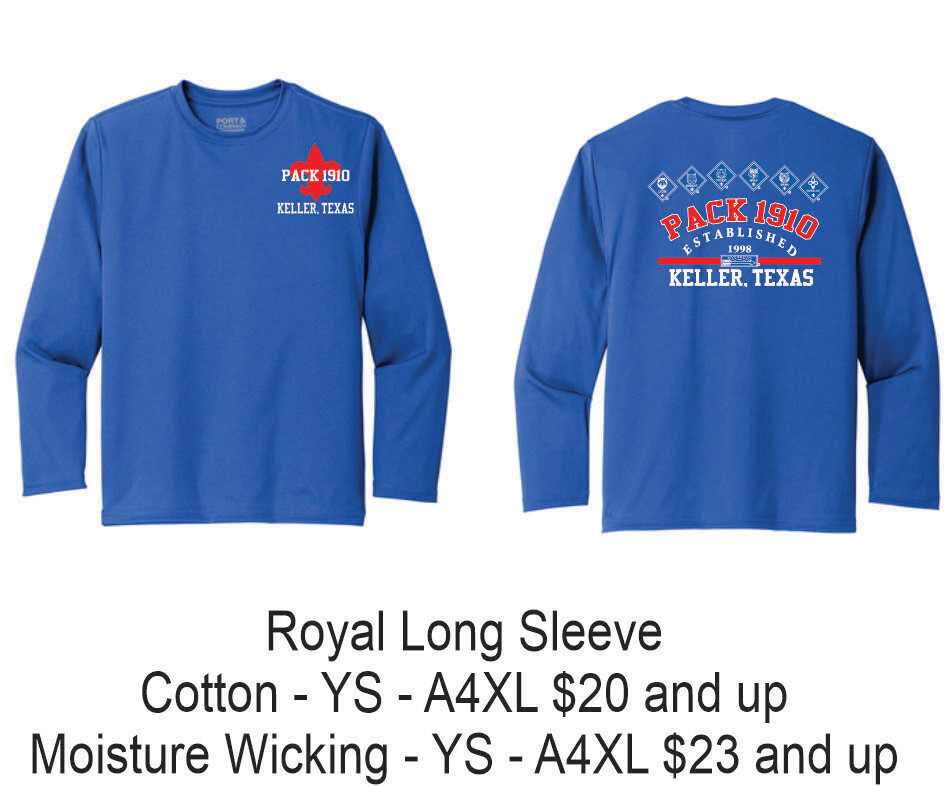
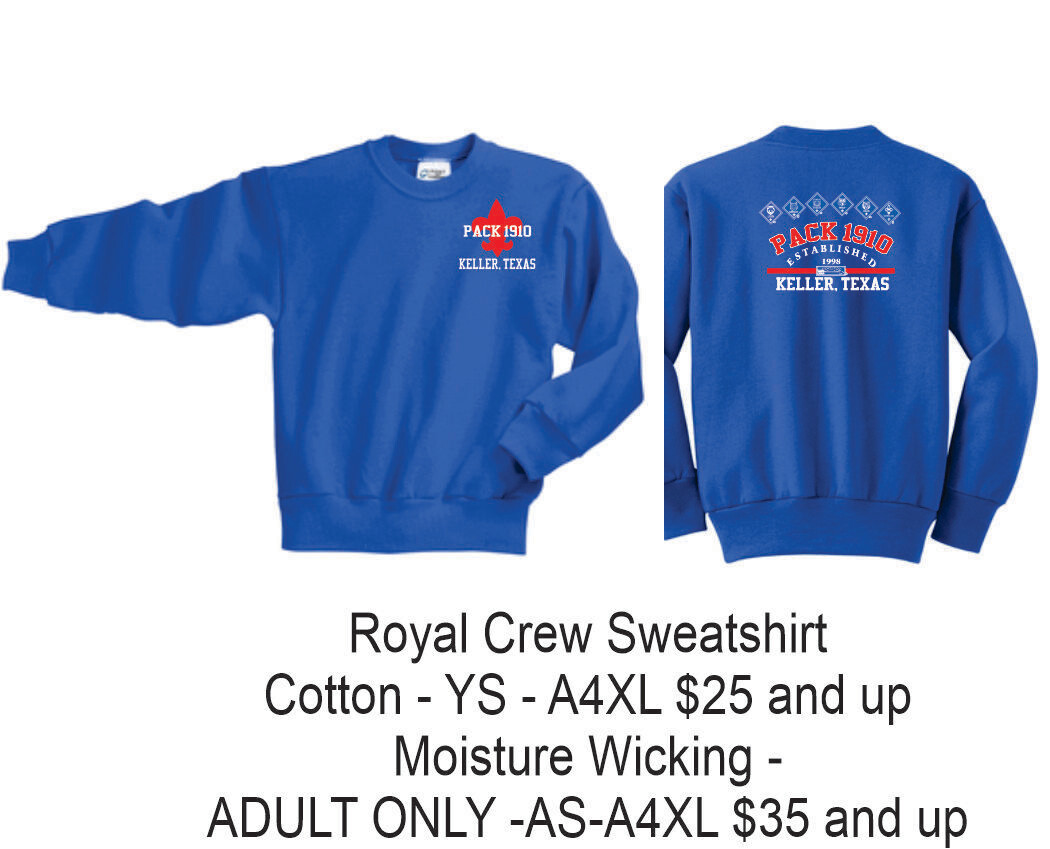
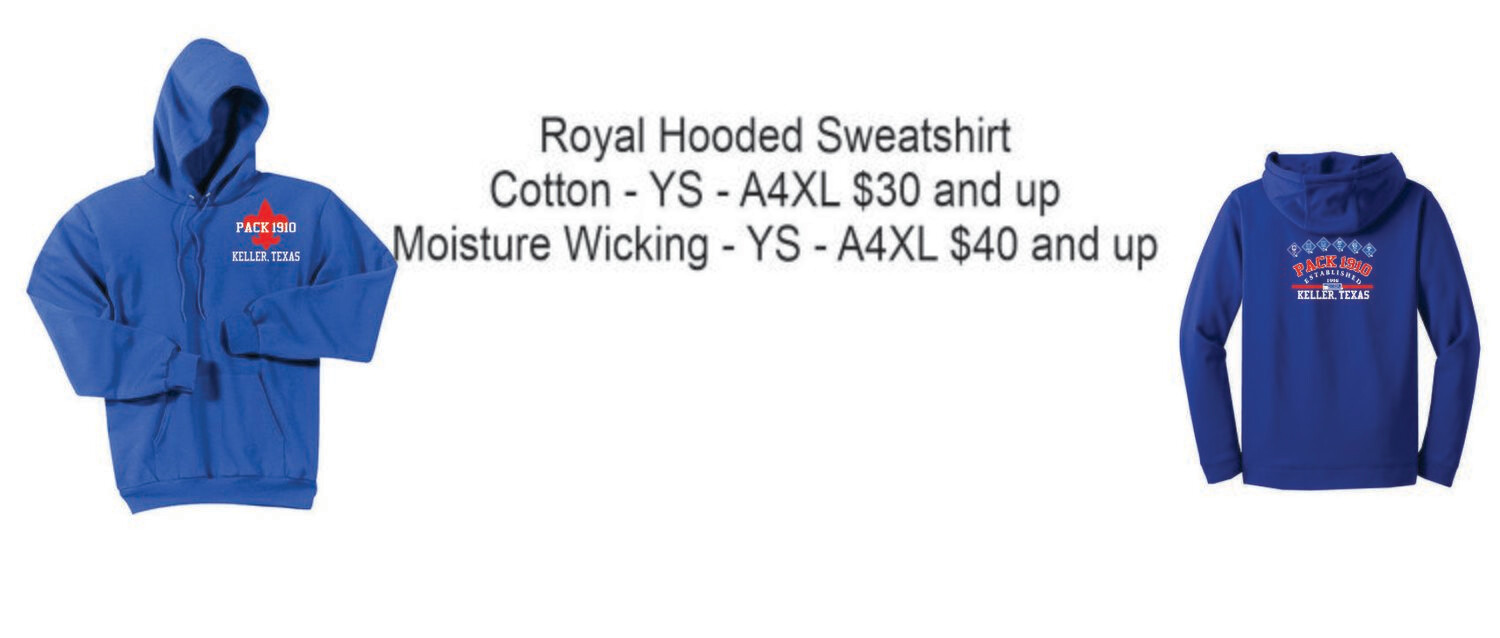
Our official design is ALSO available in long sleeved, sweatshirt AND hoodies!  If you want to purchase one of these as a Christmas gift for your scout, be sure to indicate that on your order and she will insure that it's packaged so that your Scout won't see.  (Photos below)

  
Please note -- we do not order anything other than the 50/50 to keep in inventory. Additionally, we only place one order every couple of years due to minimum order requirements, so be sure to order your shirts now and maybe an additional one to size up to for when they grow. 

We are also offering for the Scouts the option of a moisture wicking NEON shirt!  Great way to find those Scouts at a campsite or Scouting event!  


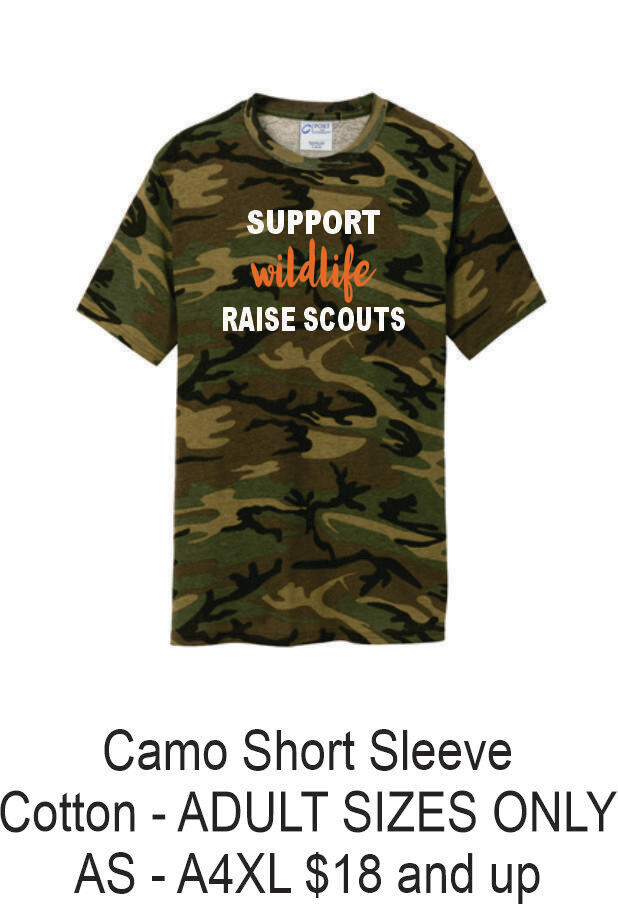
And it gets better -- we have a NEW PARENT SHIRT!


DEADLINE TO ORDER IS NOVEMBER 28.

T-SHIRTS WILL BE AVAILABLE FOR PICK UP AT THE DECEMBER PACK MEETING.

 ****PLEASE NOTE:  At the current time on the website there is the option for a white tribal design on a cammo shirt. Due to supply issues, we were unable to source YOUTH SIZED shirts and this was a design FOR the Scouts. As such, we are going to be removing this option since most of our scouts don't wear adult sizes. If this option become available at a later date, we may do a special order for anyone that wants those. However, even if the design is still up as an option on the site -- DO NOT PURCHASE THOSE AS THEY ARE NOT YOUTH SHIRTS.

Place your order by clicking the icon below. You will be taken to our storefront on Kim's Kloset.


Friday, November 12, 2021

Recharter - Deadline December 1


It’s time again to recharter our Pack with the Boy Scouts of America (BSA). As part of this process, each Scout and registered leader must renew their membership for the upcoming year (which includes payment of registration dues and ensuring your Health Form (Part A and B) is current). While our Pack operates on a SCHOOL calendar of June - May, registration dues for everyone are paid on a January-December basis.

Recharter dues for returning scouts for the 2022 calendar year are:
$150 without Scout Life magazine; or 
$162.50 with Scout Life magazine  

Leaders are $60 and require a new Background Authorization Form


FEE EXPLANATION

1) National Dues - This fee is paid directly to the Boy Scouts of America and registers your Cub Scout for the period January through December. Youth fees are $72, paid annually, prorated monthly ($6 per month) from month of joining.

2) Longhorn Council Insurance Fee - This $15 fee is paid directly to the Longhorn Council for the period of January through December. The annual Longhorn Council Insurance Fees are paid annually, prorated monthly ($1.25 per month) from the month of joining.

3) Scout Life Magazine - $12 per Scout, prorated monthly ($1 per month). Boys' Life is the monthly magazine for the Boy Scouts of America. It’s a fantastic read that reinforces Scouting and the good family values that are part of our program. This is totally optional.

4) Pack Fees - $63 (about $5 per month) The Pack charges an annual Pack Fee to help cover the cost of running the Pack. This fee includes all program costs and is set each year by the Pack Committee. At the very basic level, this covers your scout's rank specific neckerchief slide and neckerchief at bridging each May, advancement, awards, badges, patches, pins, adventure loops, hiking awards, ceremony supplies, and the like. As you can see, there are a great deal of tangible goods that each scout receives annually just for doing what they do! This doesn't even begin to cover the other costs... just what our scouts receive.

Thus, we rely heavily on fundraising to ensure an awesome program for our youth. Simply stated, our Pack is POWERED BY SCOUTS and it will take us all to ensure we can have a successful fundraiser!


Membership renewal commitments are due no later than DECEMBER 1.

Our charter expires December 31 and there is a GREAT DEAL of paper chasing to take place before then. 
PLEASE do not make us chase you for filing your paperwork.

Say it with me now... ya didn't file your paperwork... 

Checks should be made payable to Pack 1910. If you would like to pay via credit card, that can be done through Paypal on our Payment page.  If you choose to utilize the payment page which is processed through PayPal, the processing fees are passed onto you rounded up to the nearest $0.25.

Without registration commitments, we cannot recharter you (as a registered leader) your Scout. Awards and rank cannot be recorded for unregistered Scouts.

While we try to streamline this as much as process, there IS paper involved -- we need a new health form for anyone that hasn't submitted one within the last year. We need completed YPT certificates for all parents with their Scouts if you have not supplied those via e-mail.  All leaders must be trained for their positions prior to recharter. All registered leaders need to have their YPT renewed THIS YEAR. 

Please know we NEVER want finances to be a reason that a child cannot participate in Scouting. If you have a need for a scholarship, please reach out to April Driggers. She will have you complete a scholarship form. Our request of you is that you actively participate in our Unit and our fundraising programs.  If you are waiting on one for the 2022 Scouting year, they will be emailed this weekend. Thank you for your patience.

Thank you for your assistance in making this as painless and streamlined of a process as possible. I appreciate everyone's prompt attention to this matter. If you have any questions at all, please do not hesitate to contact Alison Ford who handles all things Membership.


Thursday, November 11, 2021

Scout Salute to our Veterans


Veterans Day originated as “Armistice Day” on Nov. 11, 1919, the first anniversary of the end of World War I. Congress passed a resolution in 1926 for an annual observance, and Nov. 11 became a national holiday beginning in 1938. A celebration to honor America's veterans for their patriotism, love of country, and willingness to serve and sacrifice for the common good.


Today we pay homage and give thanks to all of those who have served this great nation of ours from the United States Navy to the United States Army to the United States Air Force to the United States Marine Corps to the United States Coast Guard and each branch of reserves.


Scouting has a history rich in military service as well.  Robert Baden-Powell, the father of Boy Scouts, was a British officer with a long military career.  Much he learned along the way in his military career directly correlated with how he established scouting.  As it stands, many of our current military academies are home to a considerable amount of Scouts - over 1/3 of the cadets at West Point were involved in scouts and 16% are eagles; over 20% of the Air Force cadets were in scouting and 12% are Eagles; and 25% of the Naval Academy midshipmen were in Scouts and 11% are Eagle Scouts.  Though it's not the only way, it's definitely a great path to being a part of something much bigger than yourself.


So, today, we humbly give thanks to those who have signed their name on the line and said, "Whatever it takes... I'm here for America."  Those are the kind of courageous men and women we honor today.

Some interesting facts from History.com about veterans:


The brave men and women who serve and protect the U.S. come from all walks of life; they are parents, children and grandparents. They are friends, neighbors and coworkers, and an important part of their communities. Here are some facts about the current veteran population of the United States.


There are approximately 21 million military veterans in the United States.
  • 16.1 million living veterans served during at least one war.
  • 5.2 million veterans served in peacetime.
  • 2 million veterans are women.
  • 7 million veterans served during the Vietnam War era (1964-1975).
  • 5.5 million veterans served during the Gulf War (representing service from Aug. 2, 1990, to present).
  • Of the 16 million Americans who served during World War II (1941-1945), about 620,000 are still alive.
  • 2 million veterans served during the Korean War (1950-1953).
  • 6 million veterans served in peacetime.
  • As of 2014, 2.9 million veterans received compensation for service-connected disabilities.
  • As of 2014, 3 states have more than 1 million veterans in among their population: California (1.8 million), Florida (1.6 million), Texas (1.7 million).
  • The VA health care system had 54 hospitals in 1930, since then it has expanded to include 171 medical centers; more than 350 outpatient, community, and outreach clinics; 126 nursing home care units; and 35 live-in care facilities for injured or disabled vets.


We remember your sacrifice. We honor your patriotism. To quote President Coolidge, "The Nation which forgets its defenders will be itself forgotten.”


You are all invited tonight at 7pm to the North Texas Field of Honor at Keller Town Hall for a flag retirement ceremony conducted by Troop 1910.  

Monday, November 8, 2021

Coat Drive Turn in TOMORROW


Don't forget TOMORROW is the turn in date for the One Warm Coat Coat Drive that we are doing for our Scouts to earn his or her Messengers of Peace. 

Please be sure if you've asked your neighbors for donations, you follow up with them for donations. Great time to clean out those closets!


Friday, October 29, 2021

Every Scout Deserves a Well-Trained Leader


Although you can take most training courses for just about everything needed online through the my.Scouting portal, nothing beats tribal knowledge and networking when it comes to training.  Something you will hear many of us tenured leaders say is that "every Scout deserves a well-trained leader!"  

If you are new to Scouting, new in a particular Scouting volunteer position, or perhaps you want to step up to offer assistance in a supporting role, the University of Scouting will have courses offered for just about everything under the sun from the basics to becoming an Eagle mentor.


Saturday, November 20 is the Longhorn Council's University of Scouting. If you haven't registered, there is still time to pick your courses and make a day of it. Check out the Event Guide HERE

Early bird pricing ($25) for registration ends October 31.
Late registration ($30) is from November 1-15.
Walk-in registration is $35


(While walk-in registrations are allowed at a higher price point please consider the logistical nightmare for your volunteers who are teaching... they're busy preparing materials, handouts and such.  The courtesy of an advance registration allows them to do their job and ensure enough materials are available for those in attendance. Pre-registration is just the kind thing to do.  A Scout is kind. Register in advance.  Thankyouverymuch.)

Check in is from 8a-9a

Classes begin at 9a and last until 12p

Lunch is from 12p-1p at the TCC cafeteria (not included in registration. You may bring your own or buy something there)

Afternoon classes are 1p-4p

Closing ceremony


Wednesday, October 20, 2021

A Scout is Brave

The 8th BSA point of the Scout Law is Brave -- by definition, the polar opposite of fear. Although, I believe that both can be equally crippling. Being brave doesn't mean you're not afraid... bravery is actually to continue to move forward despite being afraid and frankly, it's something quite different for each and every one of us. 

Bravery could mean something as simple as standing on top of the monkey bars to a Tiger scout or signing your name on the line to dedicate your life serving in our nation's military. Bravery can be conquering Mt. Everest or having the courage to stand up before strangers to deliver a speech. It could be going away for the first time ever to camp without the creature comforts to which you've grown accustomed... to walking into the meeting of a brand new Pack and trying to make friends with people you don't know. 

Bravery is saying no to the wrong thing. 

Bravery can be having the courage to quit when you know the path by which you travel is not the one you intended.  Listening to that inner voice rather than the masses of people that you may have surrounded yourself with.. is very brave.


Being okay with being different... is brave. 


Bravery is... showing up... in every sense of the word.

{I do have to put a disclaimer here though -- don't let me allow ANYONE to confuse being brave with being stupid because the internet is FULL of people doing really, REALLY stupid things that don't equate to an OUNCE of bravery.} 

Thanks, I feel better now.

Every month in the Scout's Life magazine there is a feature called Scouts In Action.  Many of their stories highlight scouts all over the world who showed bravery.  Check out some of those stories the next time it arrives in your mailbox.  In fact, here's a link to the site with the previously published Scouts in Action pages from the magazine.  If you want to receive this magazine at your home, you can for $12 with your recharter.

So taking on the idea of bravery... did you know that a Scout can face danger even if they are afraid... that's being brave.  Think of all the things people are afraid of.  I'll bet that one of the top fears on more lists than you could even fathom is... 


 !!  SNAKES  !! 

There are lots of people who believe that the only good snake is a dead snake but there couldn't be anything further from the truth. Snakes are beneficial to our ecosystem in more ways than you can imagine. The way to learn to be brave if you're afraid of them is by educating yourself to identify the venomous snakes you might come across so that when you see anything other, you can simply appreciate them (and... perhaps spray them with a water hose to get them to go away if you're still not a fan).

Shaun Hayes has one of my favorite Instagram accounts @tx_snakewrangler and he has given me permission to use his photos for this post.  They're beautiful and amazing and I'm so grateful for his love of herping which enables me to share with you ways to identify these creatures.  Because, the more you know...the more you grow! Please check him out on YouTube too right here.

Coral Snake
  • Coral snakes have one of the strongest venoms of any snake, but because of their small jaws they are not considered as dangerous as rattlesnakes.
  • The snakes are usually between 18 and 20 inches long. Some grow to be 3 feet long.
  • They can be as skinny as a pencil.
  • Their heads are small and look like their tails.
  • Their fangs are always out because they cannot pull them back into their mouths. 
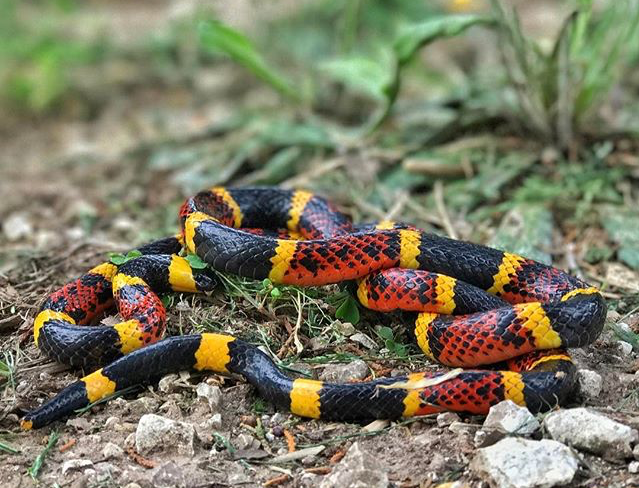
  • There is a harmless king snake that looks so much like the coral snake that people made up a rhyme about their coloring. However, it is a good idea to never pick up any snake unless there is an adult with you. The rhyme is: “Red and yellow, kill a fellow; “Red and black, just stay back.” So, if the red bands touch the yellow bands, you know it's a coral snake.
  • Coral snakes live in a variety of habitats, ranging from marshes to woods and sand hills. They also like to sleep under rotting leaves. They are often found in suburban areas as well. 
  • They eat lizards and other small snakes. 
  • They lay eggs. Babies are 7 inches long when they hatch and are fully venomous. 
  • Most people who are bitten receive the bite when they pick up the snakes or step on them with bare feet.
Here is a photo of a coral snake. See if you can find the head. See how the red touches yellow? 


Copperhead
  • Copperhead snakes get their name from their copper-red heads. 
  • They are pit vipers and have heat-sensing pits on their faces that help them detect prey. 
  • Copperheads have wide, muscular bodies with hourglass-shaped markings. 
  • They average between 2 and 3 feet long. 
  • They live in many different environments, including rocky areas, woods, and mountains; near streams, desert oases, and canyons. Nearer to humans, they also love to live in wood and sawdust piles, abandoned and overgrown yards, and old construction areas. 
  • Although they hunt alone, they are social and hibernate in dens with many other snakes. 
  • Copperheads eat mice and other small rodents, small birds, lizards, amphibians, small snakes, and insects. 
  • They use their pits to sense heat and track prey. After they bite large prey, they wait until the prey dies and then eat it. 
  • Adults sometimes eat only 10 to 12 meals a year if the meal is a larger animal. 
  • Babies are born live with fangs and venom as dangerous as an adult snake’s. 
  • Copperheads give no warning and will strike almost immediately if they feel threatened.

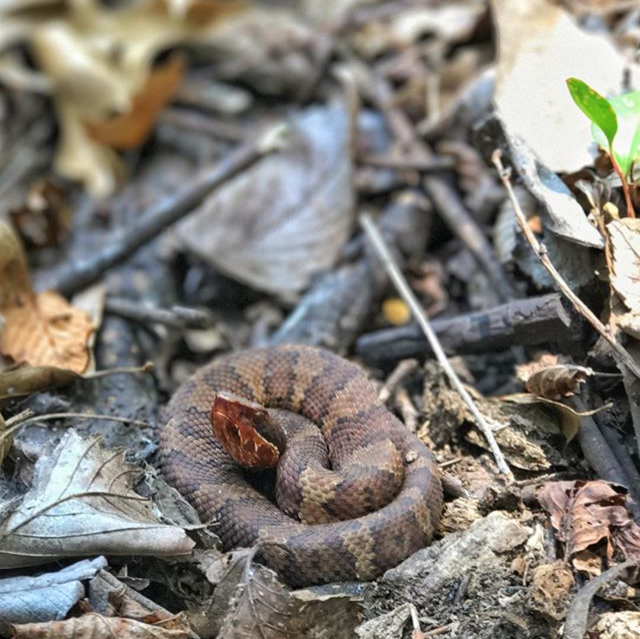
See how the pattern looks like Hershey Kisses? That's a characteristic indicative of one species of copperhead.


This is a broad banded copperhead.

Another view of a copperhead.


Rattlesnake
  • A rattlesnake’s warning sounds are hissing and rattling of its tail. 
  • Rattlers can grow to be 1 to 7 feet long. 
  • They have a distinctly triangular head. 
  • Every time a rattlesnake sheds its skin, another ring is added to the rattle on its tail. 
  • Rattlesnakes live in many different environments in North and South America. They can live anywhere from desert sands to grasslands, scrub brush, rocky hills, and swamps. They can live in high elevations, up to 11,000 feet. 
  • Texas has NINE native species of rattlers. I've only seen four in my life.
  • Generations of rattlesnakes can use the same dens for hundreds of years. 
  • They give birth every two years to live babies. 
  • They can live up to 30 years. 
  • Rattlesnakes eat small rodents, reptiles, and insects. 
  • Their strike is extremely fast. 
  • They eat about every two weeks. 
  • Most rattlesnake strikes on humans happen when the snakes are stepped or sat upon.
Diamondback rattle snake. The rattle...and diamond pattern give this one away, no?  There is an Eastern Diamondback and a Western Diamondback -- each has a coloration to help it blend in with its environment.

This is a massasauga rattler. Distinctive by the rattle (shocker) and the Pac Man pattern.

This is an Eastern Timber rattlesnake

Cottonmouth a.k.a. Water mocassin 
  • Cottonmouths are the only venomous water snake in North America, but they are also happy soaking up the heat on land. 
  • They have a triangular head and a thick body. 
  • They are also commonly called water mocassins. 
  • They are called cottonmouths because they open their mouths wide when they are threatened. The inside of the mouth is white, like cotton. 
  • They are pit vipers. 
  • Cottonmouths range from 2 to 4 feet long. 
  • They have dark vertical lines by each nostril and pale snouts. 
  • They can be found in swamps, marshes, drainage ditches, ponds, lakes, and streams or sunning themselves on land nearby. 
  • They swim with their heads out of the water. 
  • They eat fish, birds, amphibians, lizards, baby alligators, turtles, small mammals, and other snakes. 
  • Babies are born live in litters of up to 20. 
  • When threatened, cottonmouths will coil up, open their mouths, and expose their fangs.

See how white his mouth is? That's how they got their name. People try to say they're aggressive but you can see video after video of these and they stay coiled and rarely strike. I'm not saying they won't but they are not the monsters they are made out to be. Notice the sharp taper from thick to tail. Very good way to learn to ID these as they are not a slight taper like many snakes are. They go from thick to tail - BAM!

Another beautiful view of how they go from fat to end. Another reason, too, not to go sticking your hand in holes if you don't know what's in it. I zoomed in on this picture, below, too, because I want you to see the mouth and banded eyes. 


Juvenile cotton mouth - showing you some of the variations of coloration. Their tails also have a greenish tip when they're babies, too.

Wanted to show you a SIDE VIEW of the head of a water moccasin / cotton mouth. See how
the brown band runs fully along their eyes? That's another way to help you ID this species. 

If anything, nature shows us ways that camouflage and pattern mimicry help species survive and avoid predation.  For instance, the photo below shows two diamondback water snakes with a broadbanded water snake. These are constantly misidentified as cottonmouth snakes. I have personally seen more than one photo posted on Facebook (after they have been killed) by people SWEARING they're cottonmouths. I promise not every snake is a cottonmouth. 

Speaking of mimicry... I want to draw your attention to how these NON VENOMOUS snakes can flatten their heads to LOOK largely triangular (which people like to say is indicative of venomous snakes). Lots of snakes learn ways to appear big and bad so they're not messed with. Another reason to educate yourself. 


This plain bellied watersnake is frequently confused with a cottonmouth. See the vertical bars along its mouth? That's another way to identify this harmless, nonvenomous species.

Below is a video posted by the Texas Parks and Wildlife Department to help you see these species moving in the wild.


And if just watching this gave you the heebie jeebies -- thanks for being brave and making it to the end!  

Coat Drive


Pack members, please check your Scoutbook emails for a printable invitation for you to collect in your neighborhood.

Sunday, October 17, 2021

Camping Do's and Don'ts


  • Practice setting up your tent before you get on the camping trip. Make sure it is complete and you know how to put it up. Of course we will help you but you don’t want to get out there to realize you don’t have stakes or poles!
  • Plan on it getting colder than you think – you can always take off a layer or remove a blanket. Put a sheet inside your sleeping bag it keeps it clean inside and will give you a layer of warmth or a layer of cool.
  • Bring rain gear – you never know what the weather will be
  • Change clothes to sleep in. (will keep you from getting cold due to moisture in the fabric from the day and you never know what you have on your clothes that you are bringing into your tent…poison ivy)
  • Always have a tarp under your tent. Make sure none of it sticks-out from the bottom of the tent or it will collect rain and make the inside of your tent wet.
  • Allow your Scout to do as much of the work while camping as possible (help putting up the tent, carrying stuff, etc). THEY CAN DO IT!! And will be proud that they did it.
  • Store food, candy, toothpaste in your car or animal proof container but NOT your tent. They can smell it!
  • Maintain the buddy system & Youth Protection Training (YPT) at all times!

  • Never sleep in a tent with a child who is not your own. – BSA rule
  • No alcohol anywhere, anyhow, anytime. – BSA rule
  • No smoking or tobacco products in sight of Cub Scouts. – BSA rule
  • Never leave candy/chips or candy/chip wrappers or food of any kind in your tent or in your clothes in your tent. Animals can smell it. This includes toothpaste, open Gatorade and other soda cans, etc. If in doubt leave it in your car.
  • Cub Scouts should not have/use knives in Tiger and Wolf ranks. Bears and higher ranks may only bring pocket knives if they have completed the “Whittling Chip” pocket knife achievement and have their Whittlin’ Chip card or badge on their person. No knives with a blade longer than the width of a child’s palm. – BSA rule.
  • Avoid 100% cotton clothing…think wool or synthetics. Cotton stays damp and makes you feel cold.
  • Leave behind the Nintendo DS, iPod, or other electronics/game systems. This is the opportunity to get away from all that. Besides, they could get damaged or lost. BSA insurance doesn't cover that!
  • No precious toys/ jewelry – could get damaged or lost.

Friday, October 15, 2021

Adopt-A-Street Clean Up is TOMORROW


Pack 1910 has partnered with the City of Keller's Adopt-A-Street Program so that we have our own designated stretch of road to pick up which will help keep our city clean and beautiful!

We are responsible for the one-mile stretch of Bourland Road between Keller Parkway and Johnson Road.  

PICK UP IS THIS SATURDAY AT 9:15 AM

All of us working together makes it easy to do our part to continue to...
As a bonus, by participating in this community service event, many of our scouts will earn needed requirement components for their rank advancement -- Community Service and a pretty cool patch!

As always, park on at the medical complex at 100 Bourland Road. Plan to meet at 9:15 am.  Our check in is at 9am at Bear Creek Park so we will have someone doing that and then meeting the group at 9:15 in the parking lot.

All participants are asked to wear CLOSED TOE SHOES and WORK GLOVES (if you have them). If you can bring a few extra large black trash bags, that would be quite helpful.


This is an all-hands-on-deck event. Families are welcome but please be mindful that the younger siblings that require constant eyes or one-on-one supervision should probably sit this one out. The more that come, the faster it goes but it's a great way to show our support for our city and to do our part to help where others have forgotten to Leave No Trace.

Pack Camping - What Do I Need?

You guys ready for CAMPING?  Are you a little “camping-shy”? Don’t let it hold you back!! Do it for your Scout – they’ll love you for it!!


We've had a few families asking about what they need for Cub Scout camping.  First things first, all adults attending need to be Youth Protection Trained and all campers (adults/youth/siblings) need to have a completed BSA Health Form Part A and B on file with our Membership Chair, Alison Ford.


Cub Scout family camping is also referred to as "car camping." With a large enough vehicle, you're fortunate enough to be able to take just about everything AND the kitchen sink with you. But for the amount of time you'll be there, it's really not necessary. Though, a few creature comforts are definitely worth it!

So, unless you have an open-ended bank account, don't run out and buy every piece of gear you THINK you need at REI until you feel out what YOUR family requires. (If you do have an open-ended account however, I'll text you my list too.)


The best thing to do when starting to acquire gear is to start small and simple so that you can discover exactly what your family needs... and grow from there. There are plenty of seasoned camping veterans in our pack that have gear to spare so don't hesitate to put the word out if you need to borrow something.

To begin simply, you need something to sleep IN, something to sleep ON, somewhere to sit, something to wear, personal toiletries. light and water.

(Oh... and toilet paper! Don't forget the toilet paper!)

Today we're starting with something to sleep IN.

Puns make me laugh.  

The first thing you need to consider is how much space you NEED.  How many people, how much stuff. Are you tall? Do you need lots of leg room? All things to consider when determining size.

If you bring kids, you generally need more space so you might consider sizing up to accommodate all the stuff.  If you want to sleep on cots, you need to be sure you're taking into account the space they take up literally and figuratively.  If you want an air mattress inside your tent, be sure you have room for your belongings as well.
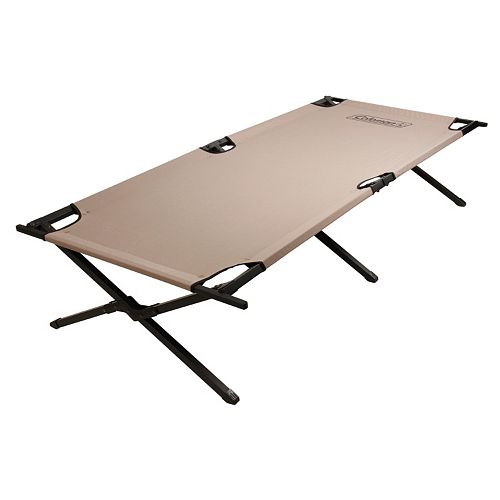
Coleman Trailhead II Cot
One perk of cots is that you can generally store gear underneath allowing for more space in the tent to move about. Do note, however, that if you plan to sleep on anything other than a sleeping mat, adding air between you and the ground means it can get really chilly if the temps drop. So be prepared with extra insulation between you and the cot or air mattress.

Do consider the bigger the tent, the more size it takes up in your vehicle and the more it weighs. Large tents that need to be heavily staked down may not be as conducive to allowing the Scouts the opportunity to help with set up.  We've had several families in the past who brought two SMALLER tents rather than one large one.  Since Cub Scout camping is "car camping" weight really shouldn't be an issue, however.

Once you've determined size, you'll need to determine what SHAPE of tent you want.  You can get dome tents or cabin tents.

Dome tents are generally lighter, easier to set up and are much more stable in high wind conditions.

Image result for dome tent

Cabin tents, however, provide more vertical space (if you're tall this might be a consideration so be sure to check the peak height listed) Some even have "rooms" where you can zip off walls (to help separate siblings who won't quit poking each other not that I have any idea what that is like.)
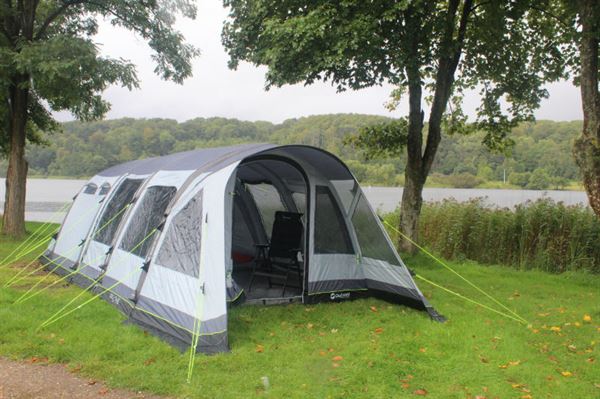
Related image
This cabin tent even has a shaded vestibule which would be perfect for chairs.

One of the tents I have is pictured below -- a dome tent with a covered vestibule which provides a place to store shoes and our cooler under cover but out of the tent's interior. Notice the full rain fly -- in order to have full circulation this DOES have to be FULLY staked down to ensure the rain fly doesn't just lay on the tent body. When you sleep, condensation will build up and you need to have that outer layer off the inner layer to prevent the condensation raindrops from falling on your head. I prefer the full fly for weather protection and privacy.  In my experience, too, a full rainfly is desirable though when it's warmer, the airflow isn't as great - something to consider.  The smaller the tent, the warmer you will be in the cooler months, however.


My suggestion is to go where you can get inside and test them out... Cabelas or Bass Pro both have tents set up in the store that you can check out.  Seriously, get inside and lay down to see just how much space you actually have and then use those dimensions to help set a minimum allowance for what you want.

My only other suggestion for you to consider is to put SOME SORT of reflective SOMETHING on your guylines to prevent people from tripping over them in the dark. Accidents happen. Tent stakes through the leg are NO fun... we try to prevent the Scouts from running between tent lines but you know how well excited children listen. Reflective tape for your guylines - you want this!

This is going to be your home away from home. You want to be comfortable and to sleep as good as you can away from your Sleep Number Bed.

Another consideration is that once your Cub Scout transitions to Scouts BSA, usually the Troop will be providing the tent. If you want to come camping with the Troop, you'll want a SMALL tent since it will be just you and your gear. At that point, small is king!

Want a list?  Check out the Pack camping list HERE.

Hope these will give you something to consider when starting to build your camping gear!